
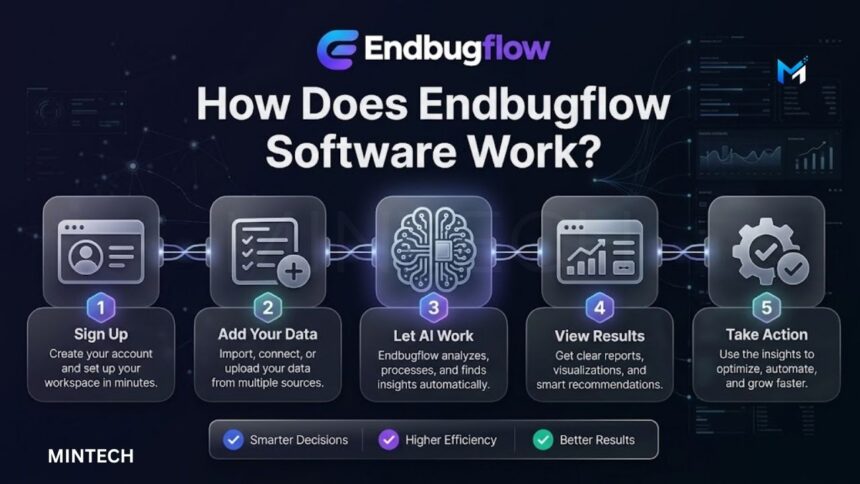
How Does Endbugflow Software Work? Understanding its purpose requires looking at how developers identify bugs, investigate unexpected behavior, test fixes, and prevent software problems from returning. Software development involves much more than writing code and launching applications. Teams must also manage error reports, analyze root causes, verify solutions, and ensure that updates do not introduce new issues. When developers handle these tasks through scattered messages, spreadsheets, and separate reporting systems, important information can become difficult to manage. This is where structured debugging practices and software workflow tools become useful.
Endbugflow is a name associated online with debugging guidance, root-cause analysis, and software workflow optimization. However, its exact capabilities require careful verification. Its public website describes a technical knowledge platform, while some third-party articles present EndBugFlow as a dedicated bug-tracking or automated debugging application. Publicly available information does not clearly establish every claimed product feature or provide a comprehensive technical manual.
Endbugflow Software – Quick Bio
| Detail | Information |
|---|---|
| Software Name | Endbugflow |
| Category | Software debugging and workflow optimization |
| Main Purpose | Understanding, tracking, and resolving software problems |
| Intended Users | Developers, QA testers, and technical teams |
| Core Focus | Bug identification and troubleshooting |
| Workflow Approach | Identify issues, investigate causes, apply fixes, and verify results |
| Potential Benefits | Better organization, clearer issue tracking, and reduced repetitive work |
| Common Use Cases | Debugging, root-cause analysis, and development workflow improvement |
| Automation | Described by some third-party sources, but specific capabilities are unverified |
| Integrations | Specific integrations are not independently confirmed |
| Official Documentation | Public technical documentation appears limited |
| Pricing | No reliably verified pricing information found |
| Availability | Supported platforms and installation options are unclear |
| Security | Security certifications and technical safeguards are not independently verified |
| Official Website | endbugflow.com |
| Overall Status | Public product details remain inconsistent |
What Is Endbugflow Software?
Endbugflow is associated with software debugging, technical problem-solving, and workflow optimization. Debugging means identifying the cause of a software problem and correcting it. For example, a website might display an error when customers submit a form, or a mobile application might stop responding after an update. Developers need a reliable way to understand what happened, reproduce the problem, and determine which part of the application requires attention.
Some online descriptions present EndBugflow as a tool that collects error information, organizes reported problems, supports team collaboration, and helps developers follow issues until resolution. These functions resemble those found in established bug-tracking and error-monitoring systems. However, the available public documentation does not independently confirm every feature attributed to Endbugflow. Therefore, it is more accurate to describe these functions as a proposed or reported workflow rather than a complete list of verified capabilities. Users should confirm whether a specific downloadable product, account-based service, or documented integration is available before treating Endbugflow as a conventional software platform.
How Does Endbugflow Software Work?
A structured debugging workflow usually begins when someone discovers a problem. The issue might appear during testing, after a software update, or while a customer uses an application. The person reporting the problem records what happened, which action caused it, and whether the error occurs repeatedly. If a monitoring system is connected, it may also collect technical information such as error messages, timestamps, application versions, and relevant logs. Some descriptions of Endbugflow refer to this type of error capture, although its precise implementation has not been fully documented publicly.
The next steps involve organizing the issue, investigating its cause, applying a correction, and testing the result. A developer reviews the available evidence, checks the relevant code, and attempts to reproduce the error. After making a change, the team tests whether the problem has disappeared and checks for unintended side effects. If the correction works, the issue can be marked as resolved; if it fails, the investigation continues. This is a standard software-development process that helps explain the workflow associated with Endbugflow, but it should not be mistaken for proof that every stage is automated within the named product.
Main Features Associated With Endbugflow
The features attributed to Endbugflow vary across online articles. Common descriptions mention issue tracking, debugging support, error reporting, workflow organization, and collaboration. In a fully documented platform, issue tracking would give a team a central place to record problems and monitor their status. Error reporting could preserve technical information, while workflow management could help developers organize tasks according to urgency and responsibility. These capabilities can be useful when a team handles multiple bugs across different application versions.
Other descriptions mention automated error collection, integrations with development tools, performance monitoring, and root-cause analysis. Such capabilities are technically plausible, but their availability in Endbugflow should be confirmed through product documentation rather than assumed from general descriptions. A genuine product evaluation should establish which operating systems it supports, whether it requires an installation or browser account, what integrations are available, and whether features depend on a paid subscription. Without that evidence, users cannot reliably determine whether Endbugflow offers a complete software solution or primarily provides educational content about debugging practices.
How Beginners Can Understand the Debugging Workflow
Beginners can understand the basic process through a simple example. Imagine that you manage an online store, and customers report that the checkout button sometimes fails. The first step is to record the issue, including the page involved, the action that triggers the failure, and any error message that appears. The team then checks browser logs, server responses, and recent code changes. This evidence helps developers narrow down possible causes instead of guessing which part of the website is responsible.
Once the cause becomes clearer, a developer makes a correction and tests the checkout process again. The team should also test related functions, such as payment confirmation and order creation, to make sure the change has not created another problem. Finally, the issue record should explain what went wrong, what changed, and how the team verified the solution. A debugging platform can help organize these steps if it supports the required functions. However, the same process can also be managed through other issue trackers, testing tools, and version-control systems. Beginners should learn the underlying method before choosing a particular product.
Explore More Unique Article: Anuel AA Net Worth
Benefits of a Structured Endbugflow-Style Workflow
One potential benefit of structured debugging is better organization. When developers record errors in a central system, they can review outstanding problems without searching through multiple conversations. Clear descriptions, reproducible steps, and relevant logs also make it easier for team members to understand an issue. This can reduce repeated questions and help developers spend more time investigating the actual cause. For small teams, even a basic and consistent reporting process can make development work easier to manage.
Another potential benefit is improved accountability. When each issue has a status, an owner, and a record of testing, the team can see which problems remain unresolved. A documented process also makes it easier to recognize recurring failures and identify areas that require better testing. These are general benefits of organized debugging, not independently measured results for Endbugflow. There is insufficient verified evidence to claim a specific percentage improvement in productivity, faster resolution times, or lower development costs for this particular name. Actual results depend on the software used, the team’s skills, the quality of its reports, and the complexity of its applications.
Limitations and Challenges to Consider
The most important limitation is the lack of clear, independently verifiable product information. Public descriptions of Endbugflow do not consistently agree on whether it is primarily an educational website, a bug-tracking platform, a command-line utility, or a broader debugging service. A developer considering adoption should first establish exactly what is being offered. Look for a functioning product demonstration, official documentation, installation instructions, a clear publisher identity, release history, support information, and transparent pricing. If those details are missing, it becomes difficult to assess reliability or suitability for professional work.
A second limitation concerns the general nature of debugging automation. No monitoring or issue-management tool can guarantee that every software error will be detected or that every proposed solution will be correct. Developers still need to understand the application, reproduce problems, review code, and test changes. Automated systems may generate duplicate alerts, miss unusual errors, or produce too much information to investigate efficiently. Teams must also consider the time needed to configure integrations and train users. Before adopting Endbugflow, compare its verified capabilities with the team’s actual requirements rather than assuming that its name or online descriptions guarantee a particular result.
Security, Privacy, and Data Protection
Debugging tools can handle sensitive technical information. Error reports may contain file paths, account identifiers, request details, internal URLs, or snippets of application data. Depending on how a tool is configured, logs may also accidentally expose passwords, authentication tokens, or personal information. Before connecting any debugging service to a live application, developers should understand what data it collects, where that information is stored, who can access it, and how long it is retained.
For Endbugflow specifically, users should verify its privacy policy, data-handling practices, access controls, and security documentation before uploading source code or production logs. Avoid granting broad access to repositories or live systems until the publisher and the requested permissions have been checked. Test unfamiliar tools with non-sensitive sample data first, and remove secrets from logs whenever possible. If a platform does not clearly explain how it protects information, that uncertainty is a valid reason to delay adoption. Security checks are particularly important for businesses that handle customer records, payment information, or confidential intellectual property.
Endbugflow Compared With Traditional Debugging Tools
Traditional debugging tools serve different purposes. A code editor helps developers inspect and modify source code, while a debugger allows them to pause execution, inspect variables, and follow program behavior. A bug tracker records reported issues and helps teams manage assignments, deadlines, and status changes. Error-monitoring systems collect information about failures in running applications. These tools can work together, but they are not interchangeable.
Endbugflow is described online in ways that overlap with several of these categories, yet its exact position in the software-development ecosystem remains unclear. That makes a direct comparison difficult without verified feature lists and hands-on testing. Before choosing it, identify the problem you need to solve. If you need source-code debugging, look for a compatible debugger. If you need to coordinate tasks, evaluate an established issue tracker. If you need to identify production errors, consider a documented monitoring service. Compare Endbugflow only after confirming that it offers the specific functions, integrations, support, and security controls your project requires.
Who Should Consider Endbugflow?
Developers who want to improve their debugging process may find Endbugflow-related educational material useful for learning how to document errors, analyze root causes, and organize technical work. Beginners can benefit from understanding the sequence of reporting, investigation, correction, and verification. Small development teams can also benefit from adopting consistent issue-reporting practices, even if they initially use tools they already have.
However, anyone considering Endbugflow as a production software product should verify its identity and capabilities before depending on it. Businesses should conduct a technical and security review, while individual developers should confirm installation requirements, compatibility, cost, and support. It may be worth testing if a verifiable product meets a clear need, but there is not enough reliable public evidence to recommend it unconditionally. Choosing a tool based on demonstrated functionality is more useful than relying on repeated claims across websites.
Conclusion
Endbugflow is associated with debugging, root-cause analysis, and workflow optimization, but public descriptions do not establish a single, fully verified definition of the software. Some sources describe it as an issue-management and debugging platform, while its public-facing website presents itself as a technical knowledge resource. Understanding this distinction is essential before assuming that it offers automated bug detection, team integrations, monitoring, or other specific capabilities. The most reliable approach is to verify the product’s documentation, publisher, features, and security practices before installing it or connecting it to important systems.
The underlying debugging workflow remains valuable regardless of which tool a team chooses. Developers should record errors clearly, collect relevant evidence, investigate causes, apply corrections, and test the results. A well-designed tool can support this process, but it cannot replace technical judgment or proper quality assurance. For beginners, learning these fundamentals is the best starting point. For experienced teams, a careful product evaluation can determine whether Endbugflow provides a practical benefit or whether a better-documented alternative is more suitable.
Frequently Asked Questions
What is Endbugflow software?
Endbugflow is associated with debugging guidance and workflow optimization. Some online sources describe it as a bug-tracking tool, but its exact product identity and capabilities are not fully verified.
How does Endbugflow software work?
Descriptions associate it with recording software issues, organizing technical information, investigating errors, and managing fixes. The exact workflow available in a specific Endbugflow product should be verified.
Is Endbugflow suitable for beginners?
Its debugging-related material may help beginners understand software problem-solving. Anyone planning to install a product should first confirm that it is legitimate, documented, and compatible with their needs.
What are the benefits of Endbugflow?
A structured debugging workflow can improve organization, collaboration, issue tracking, and accountability. These are general benefits, not proven performance results for Endbugflow specifically.
Does Endbugflow automatically fix bugs?
There is insufficient independently verified documentation to establish that Endbugflow automatically repairs software errors. Developers should confirm any automation claims before relying on them.
Is Endbugflow free?
Reliable, confirmed pricing information is not clearly established in the public information reviewed for this guide. Check the product’s official pricing details before making a purchase.
STAY FOR MORE UPDATE: MINTECH