

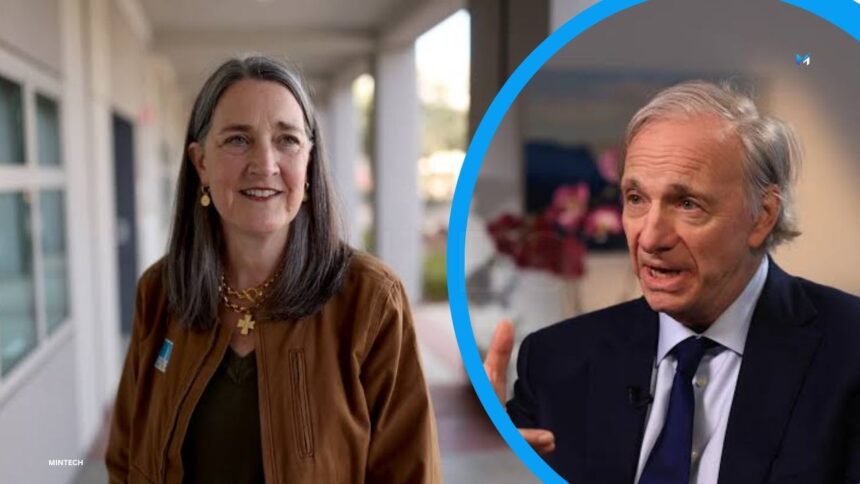
Ray Dalio and Patricia Poppe lead very different organizations, yet both of them command serious attention across the global business world. One built a famous investment firm, while the other steers one of America’s largest utilities. This guide explains who they are, what they achieved, and why readers keep searching for them together.
Each section below stays factual and easy to follow, covering their early lives, career milestones, leadership styles, and practical lessons you can apply at work. We do not claim any personal partnership between them, so we compare their paths side by side instead.
Quick Bio Ray Dalio and Patricia Poppe
| Detail | Ray Dalio | Patricia Poppe |
|---|---|---|
| Full Name | Raymond Thomas Dalio | Patricia Kessler Poppe |
| Popular Name | Ray Dalio | Patti Poppe |
| Born | August 8, 1949 | 1969 (as widely reported) |
| Nationality | American | American |
| Education | C.W. Post College (Long Island University) and Harvard Business School (MBA) | Purdue University and Stanford Graduate School of Business |
| Profession | Investor, author, and philanthropist | Utility executive and business leader |
| Industry | Investment management | Energy and utilities |
| Main Organization | Bridgewater Associates (founder) | PG&E Corporation (CEO) |
| Career Start | Founded Bridgewater in 1975 | Joined General Motors in 1990 |
| Key Milestone | Built Bridgewater into one of the world’s largest hedge funds | CEO of CMS Energy (2016 to 2020), then CEO of PG&E |
| Current Role | Founder and mentor at Bridgewater | CEO of PG&E Corporation |
| Signature Work | Principles: Life and Work (2017) | A people-first “love works” leadership approach |
| Leadership Style | Radical transparency and principles-based decisions | Customer focus, safety, and Lean operations |
| Known For | Economic cycles, debt analysis, and investing frameworks | Utility turnaround, wildfire safety, and affordability |
| Family | Wife Barbara Dalio and four sons | Husband Eric Poppe and two children |
Who Is Ray Dalio

Ray Dalio is an American investor, author, and philanthropist who founded Bridgewater Associates in 1975 and still influences how many people think about money. Born in 1949 in Queens, New York, he grew up on Long Island in a middle-class family, where his father worked as a jazz musician. Dalio often credits that ordinary upbringing for his curiosity about money, markets, and the way people make financial decisions. Over five decades, he turned a small advisory firm into one of the largest hedge funds in the world.
Dalio’s public profile extends well beyond Wall Street, and his writing helped create that wider reputation among general readers. He wrote Principles: Life and Work in 2017, and the book reached bestseller lists around the world. He later published Principles for Navigating Big Debt Crises and Principles for Dealing with the Changing World Order, which analyze how economies rise and decline over many decades. Together with his wife, Barbara, he supports ocean exploration, education, and mental health programs through their philanthropic work.
Explore More Dave Calhoun and Maria Asunción Aramburuzabala: Two Business Leaders, Two Remarkable Journeys
Early Life and Education of Ray Dalio
Dalio grew up on Long Island, where he attended public schools and developed an early interest in the stock market through the adults around him. At age twelve, he caddied at a local golf club and listened to members discuss stocks between holes. He bought shares of Northeast Airlines with his caddie earnings, and the price rose sharply after a merger. That lucky win hooked him on markets for life. He later described the experience as the moment he realized that curiosity, risk, and careful research could reward patient learners with real results.
Dalio studied at C.W. Post College of Long Island University and graduated in 1971, then earned an MBA from Harvard Business School in 1973. During his early career, he worked on the New York Stock Exchange floor and traded commodities for Shearson Hayden Stone, where he learned how markets operate. Those jobs taught him how fast conditions change and how often experts get their predictions wrong.
How Ray Dalio Built Bridgewater Associates
Dalio launched Bridgewater Associates in 1975 from a two-bedroom apartment in New York, where he offered commodity advice and risk research to corporate clients. He focused on understanding how economic machines work, and he built models that tracked debt, inflation, and growth across countries. Over time, large institutions such as pension funds and foundations began trusting Bridgewater with their money. The firm grew steadily and eventually moved its headquarters to Westport, Connecticut, where it still operates today.
Bridgewater became famous for its Pure Alpha and All Weather strategies, which pursue returns in different ways. Pure Alpha seeks gains through active global bets, while All Weather aims to perform across varied economic conditions. The firm also gained attention for an unusual workplace culture that recorded meetings and encouraged open disagreement among colleagues. Dalio gradually handed daily management to a new generation of leaders and shifted into a mentor role.
Ray Dalio’s Principles and Investment Philosophy
Dalio’s best-known idea is radical transparency, which means people share honest opinions and record important conversations so everyone can learn from them. He pairs it with an idea meritocracy, where the best arguments win regardless of a person’s rank or title. Dalio also teaches a simple growth formula: pain plus reflection equals progress. He believes people should treat mistakes as puzzles and search patiently for the root cause.
In investing, Dalio studies long debt cycles and the forces that move entire economies over time. He argues that credit, productivity, and politics interact in patterns that repeat across history, and his books explain these patterns in plain language. He also advocates diversification, which means holding assets that behave differently when conditions change. Many individual investors borrow this idea when they build balanced portfolios for the long term.
Who Is Patricia Poppe

Patricia Kessler Poppe, widely known as Patti Poppe, is an American executive who leads PG&E Corporation. She studied engineering at Purdue University and later earned a master’s degree in management from Stanford’s Graduate School of Business. Colleagues describe her as energetic, direct, and deeply focused on customers, and she has said she approaches leadership with love and discipline at the same time. Her career spans the automotive and energy industries, and she has held top roles at companies that serve millions of people.
Poppe also stands out for a rare achievement, because reports describe her as the first woman to serve as CEO of one Fortune 500 company and then become CEO of another. The Automotive Hall of Fame has also recognized her contributions. Beyond the boardroom, she shares her family life with her husband, Eric, and their two children. Poppe speaks often at conferences and in interviews, where she explains her Lean approach in everyday language.
Patricia Poppe’s Career Journey in the Energy Industry
Poppe began her career at General Motors in 1990 and spent about fifteen years there, working in plant operations, directing a power plant, and later leading energy optimization. Those roles taught her how manufacturing systems use Lean methods to remove waste and improve quality. She also earned her Stanford degree in 2005 while building her operational skills. These experiences prepared her to move into the utility sector, where reliability and safety carry enormous consequences for families and businesses. Her factory-floor background still shapes how she talks about work, teams, and everyday improvement. She often says those early years taught her to respect frontline workers and trust simple, repeatable routines.
In 2011, Poppe joined CMS Energy and its main subsidiary, Consumers Energy, in Michigan, and she rose through several leadership roles. She became president and CEO of CMS Energy in July 2016. Under her leadership, the company set plans to cut emissions, retire coal plants, and expand renewable energy. She also pushed a people-first culture that linked safety, quality, and customer value. Those results caught the attention of PG&E’s board, which needed a new leader after years of crisis, and her Michigan record gave her credibility when she accepted a much bigger and tougher challenge in California. She also spoke often about safety, which became a central message for employees.
Patricia Poppe’s Leadership at Consumers Energy and PG&E
At Consumers Energy, Poppe promoted the idea that employees closest to the work know best how to improve it. She introduced Lean tools, daily problem solving, and a clear focus on safety and customers. Employees learned to spot waste, test fixes, and share results across teams, while Poppe spoke openly about her expectations and showed up on the front lines. Those habits helped the company improve its safety record and strengthen its public image. Many observers saw her Michigan tenure as proof that culture change can drive measurable progress in a regulated industry.
PG&E named Poppe CEO effective January 4, 2021, shortly after the company emerged from bankruptcy tied to deadly wildfires. She inherited a heavy burden, including aging equipment, public anger, and billions of dollars in required upgrades. Since then, she has promoted wildfire safety, grid modernization, and affordability for customers. In October 2026, she told Fortune that artificial intelligence could help the grid, and she also urged wildfire policy reform. Critics still question costs and past failures, so her work remains closely watched by regulators, customers, and investors alike.
Key Differences Between Ray Dalio and Patricia Poppe
Although both leaders emphasize process, their worlds differ sharply, because Dalio founded and shaped a private investment firm, so he set the rules from day one. Poppe, by contrast, leads a publicly traded utility that answers to regulators, customers, shareholders, and elected officials who all want different outcomes. Dalio studies markets and economic cycles, while Poppe manages poles, wires, crews, and emergency response. Their success metrics also differ, because investors measure returns, whereas utility customers judge reliability, safety, and monthly bills. Those contrasts make the comparison useful, since each leader solves problems under very different constraints. Understanding those differences helps readers avoid unfair comparisons and focus on lessons that actually transfer between fields.
Their communication styles diverge as well, since Dalio writes long books and publishes videos that explain big economic ideas in a patient, teacher-like tone. Poppe speaks in short, energetic phrases and often highlights emotion, service, and human connection. Dalio built his reputation on radical transparency and data-driven debate, while Poppe leans on Lean thinking and love as a management language. Neither approach works best in every setting, so readers should match the method to their own team, industry, and goals instead of copying a single leader’s playbook.
Shared Leadership Values and Common Ground
Despite their different industries, Dalio and Poppe share several core beliefs about how organizations should work. Both leaders treat mistakes as chances to learn rather than reasons to hide. Both build systems that help ordinary people make better decisions every day, since Dalio writes down principles and Poppe uses Lean routines to standardize improvement. They also talk openly about values, which makes their expectations easier to understand. Each leader believes culture drives results, so they spend serious time shaping how teams think, speak, and solve problems together. Their shared emphasis on learning loops means progress comes from repeated testing, honest feedback, and steady adjustment rather than dramatic reinvention.
Both leaders also show persistence under pressure, as Dalio endured a major financial setback in 1982 and rebuilt his thinking after a painful forecasting error. Poppe stepped into a utility facing public anger, legal pressure, and complex safety challenges. In each case, the leader stayed focused on long-term improvement instead of quick applause. They also share a habit of teaching, since both explain their methods through speeches, books, and interviews. Readers who study these habits can borrow practical tools without needing the same title, budget, or industry. Their common ground proves that strong principles can work in very different environments, from trading floors to power plants and customer call centers.
Why Ray Dalio and Patricia Poppe Matter Today
Dalio matters because economic uncertainty remains high, and many people want frameworks to understand debt, inflation, and global power shifts. His books and videos give readers a structured way to think about those forces. Whether you agree with his conclusions or not, his emphasis on evidence and humility encourages better questions. He also shows how a founder can turn personal lessons into a shareable system that others can test. As a result, students, investors, and managers continue to study his work, and his influence reaches far beyond the client list at Bridgewater. In uncertain times, readers value teachers who show their reasoning instead of simply announcing predictions.
Poppe matters because electricity now powers almost every part of modern life, and data centers, electric vehicles, and heat waves all increase pressure on the grid. PG&E serves about sixteen million Californians, so her decisions affect homes, schools, hospitals, and businesses. Her focus on safety, affordability, and technology shows how utilities must adapt quickly. Supporters credit her for bringing energy and clarity to a troubled company, while critics keep pressing for lower bills and fewer fires. Either way, her leadership offers a live case study in managing infrastructure under intense public scrutiny. Her results will also influence how other utilities respond to wildfire risk, rising demand, and customer concerns about cost.
Lessons Readers Can Learn from Both Leaders
First, write down what you learn, because Dalio records his mistakes and turns them into principles that help him avoid repeating costly errors. You can copy that habit with a simple weekly review of decisions and outcomes. Second, listen to people close to the work, as Poppe does, since frontline employees often see problems long before executives notice them. Third, make expectations clear, because both leaders explain their values openly and teams know what good performance looks like. These small steps cost little, yet they can improve trust and results in almost any workplace. Start with one habit this week, and you will see how quickly small routines build confidence.
Fourth, balance data with humanity, since Dalio relies on evidence and debate, while Poppe adds care and connection to her management style, and together those ideas form a strong mix of logic and empathy. Fifth, stay patient during hard seasons, because culture change rarely happens overnight. Finally, stay humble about what you do not know, since Dalio admits he has been wrong and Poppe keeps learning from customers and crews. Use these lessons as inspiration rather than strict rules, and adjust them for your own industry, budget, and team size. Small, steady improvements compound over time, and patient readers who apply them consistently often outperform those chasing quick fixes.
Read more Mary Barra and David Cordani: Net Worth, Careers, and Leadership Compared
Conclusion
Ray Dalio and Patricia Poppe show that great leadership takes many forms. Dalio built a global investment firm around principles and open debate, while Poppe leads a major utility through safety, affordability, and ongoing change. Their careers differ, yet both rely on learning, systems, and culture.
Frequently Asked Questions
Who is Ray Dalio?
Ray Dalio is an American investor and author who founded Bridgewater Associates in 1975.
Who is Patricia Poppe?
Patricia “Patti” Poppe is an American executive and the CEO of PG&E Corporation.
Are Ray Dalio and Patricia Poppe business partners?
No public evidence shows a formal partnership. This article compares their careers and leadership styles only.
What is Ray Dalio best known for?
He is best known for founding Bridgewater, writing Principles, and promoting radical transparency.
What did Patti Poppe do before joining PG&E?
She worked at General Motors from 1990, then joined CMS Energy and led it as CEO from 2016 to 2020.
Stay More Update MINTECH